
Read your homepage headline out loud to a buyer who has never heard of you. If they cannot tell you who it is for, what it replaces and why it wins, your positioning is not on the page yet. Most homepages fail this in under five seconds, and the fix starts long before anyone opens a design file.
Why does one line carry so much weight?
When I became the first product marketer at AccuKnox, a Zero Trust CNAPP and AI security startup, we had a strong technical platform and no written positioning. Every rep told a different story. New product lines had no launch plan, and the field was crowded with well funded rivals.
The homepage was a symptom, not the disease. We fixed it in the order I still use today: positioning first, then enablement, then launch. That three phase shape is what I now run as PMM in a box. I was part of the team on the 0 to $10M hypergrowth journey that followed, and the lesson I wrote down in the PMM case study still holds. Product marketing pays off when sales repeats the story without help.
Your hero line is the cheapest place to check whether that story exists at all.
What is positioning, actually?
April Dunford's quickstart guide to positioning defines it as how your product leads at something a clearly defined group of customers cares deeply about. She breaks it into five components, and she wants you to work through them in this order.
- Competitive alternatives. What customers would do if you did not exist, including doing nothing.
- Differentiated capabilities. What you have that those alternatives lack.
- Value. The outcome those capabilities make possible for the buyer.
- Target customers. The segment that cares most about that value.
- Market category. The context that makes your value obvious to that segment.
The order matters. Dunford argues that starting from features gives you positioning that sounds great in the office and means little to a buyer.
In her guide to advanced B2B positioning in Lenny's Newsletter, she pushes the point further. "The prospect's view of competitive alternatives is the only one that matters." She also notes that B2B vendors typically lose about half their opportunities to whatever the prospect already uses, and she has worked with companies where that share passes 80%.
So your real rival is often a spreadsheet, a manual process or the incumbent tool. A headline that only fights the startup you meet at conferences ignores the alternative that beats you most often.
Her best known example is Janna Systems, an enterprise CRM up against Siebel, a far bigger rival. An investment bank customer showed the team what its relationship modelling was really worth. Janna repositioned as CRM for investment banks and, by Dunford's account, grew from under $2M to close to $80M over the next 18 months before Siebel acquired it. Same product, different frame.
Positioning is not the headline
Emily Kramer at MKT1 draws a clean line between the two. Her MKT1 guide to positioning treats positioning as the core answer to who it is for, what it is and how it differs. Messaging is how you apply that answer to each audience, channel and funnel stage. "Positioning is ultimately about comparison," she writes.
In a positioning and messaging teardown with Anthony Pierri, the two pull apart the Pocus homepage. Their advice fits almost every B2B SaaS site I look at.
- Lead with one primary audience and send other segments to their own pages.
- Pick one land use case instead of listing everything the product does.
- Compare against the old way of working, not the newest competitor.
- Keep generic revenue promises out of the top third of the page, because every sales tool makes them.
The one line test
Write your homepage hero as one sentence. Then score it against four questions that map straight onto Dunford's components.
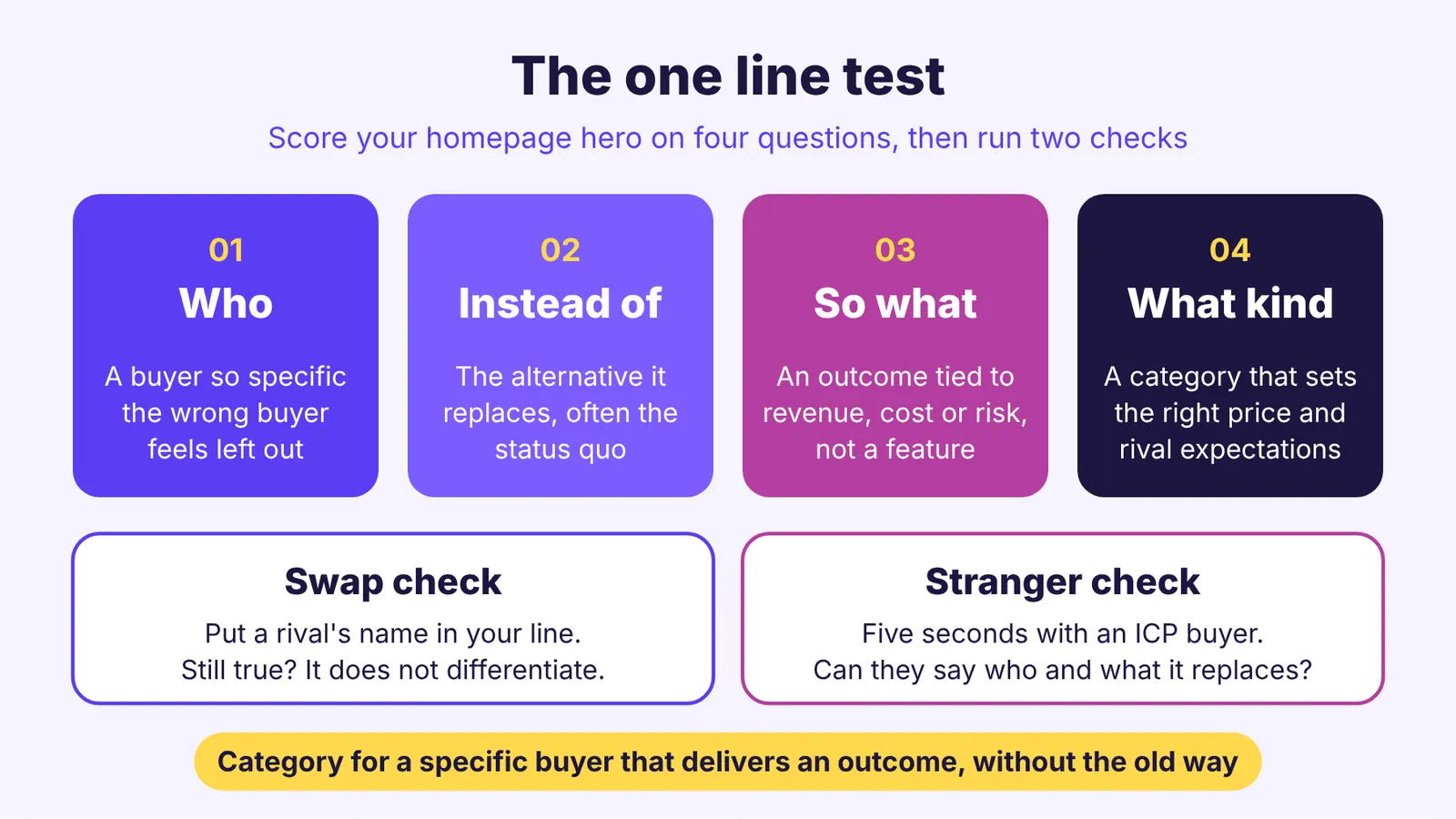
- Who. Does it name a buyer specific enough that the wrong buyer feels left out?
- Instead of what. Does a reader know what this replaces, even if you never name a rival?
- So what. Is the benefit an outcome the buyer pays for, such as revenue, cost or risk, rather than a feature?
- What kind of thing. Does the category set the right expectations for price and competitors?
Then run two quick checks.
- The swap check. Put your top competitor's name in place of yours. If the line is still true, it does not differentiate you.
- The stranger check. Show the line for five seconds to someone who fits your ICP and has never seen your site. Ask them to say back who it is for and what it replaces. If they guess wrong, the line fails, however much the team loves it.
A line that passes usually follows a plain shape. Category for a specific buyer that delivers an outcome, without the old way. It will not win a copywriting award. It will get understood, and on a homepage that is the whole job.
A repositioning you can study
Userlist is a small SaaS company with an unusually open write up. Cofounder Jane Portman describes in how Userlist overhauled its positioning how the team used Dunford's method in 2019.
Userlist had sat in email automation, which invited comparisons with Drip, ConvertKit and ActiveCampaign. The team listed the real alternatives, including manual follow up with new customers and building a tool in house. They picked small SaaS teams as the target and moved into customer messaging, aiming to win a smaller pond inside a category Intercom dominates.
The new headline became "Send the Right Message at the Right Time." The product itself did not change. Portman reports that prospects understood the product faster, though the post shares no hard numbers. I trust that more than a neat chart.
Notice what moved. The alternatives came first, the segment narrowed, and the category followed. The headline was the last thing written.
How I run it on technical products
Security, cloud and AI products fail this test more than most, because the team knows the technology too well. The hero ends up as a list of acronyms that only an insider can decode.
That is why the first 30 days of PMM in a box are research, not copy. Ten to fifteen customer and prospect interviews, a teardown of the top three rivals, then a positioning framework. The homepage message rewrite comes after, because the line is only as good as the interviews behind it. If you want to see where your wider GTM stands first, the GTM health check asks, among other things, whether every rep can explain your positioning the same way in under a minute.
What to do this week
- Paste your current hero line into a doc and score it on the four questions.
- Run the swap check against your two closest competitors.
- Show the line to three ICP buyers for five seconds each and write down what they say back.
- Ask five reps what a customer would do if you did not exist. If the answers differ, fix the positioning before the copy.
- Rewrite the line using the plain shape above, then test it again.
If you want a second pair of eyes, request the free audit on PMM in a box and I will record the three changes I would make first.
Subscribe to Pipeline Notes at https://syedhadi.substack.com for more practical GTM teardowns like this one.