
Your next buyer will not read ten blue links. They will ask ChatGPT or Gemini which CNAPP vendors to shortlist, get three to five names, and move on. This issue shows how we got AccuKnox into that answer, ahead of much larger names, and what the same engine did to traffic.
Last week I mapped the six GTM plays behind our 0 to $10M run. This is play four, taken apart.
The shortlist now forms before the click
Kevin Indig ran a user study of Google AI Mode with Clickstream Solutions and wrote it up on Search Engine Journal. The numbers should worry anyone who lives on organic traffic:
- 77.6% of sessions had zero external visits
- About 88% of first interactions were with the AI text, not the links
- On a "Ramp vs Brex" comparison task, 83% of exits went to review sites
His summary is that users "discover products and form opinions about them in AI Mode." His advice follows from that. Stop chasing the click and start earning the citation.
For a security vendor this is worse, because CNAPP shortlists are comparison questions by nature. If the answer engine does not name you, sales never hears about the deal.
Where we started
AccuKnox competed with much larger, better funded vendors that already owned the classic SEO results. We could not outspend them. We had to show up in both Google and AI answers anyway.
So we ran it in three phases with one owner, the same shape I now use in AEO/SEO Ranking in a box.
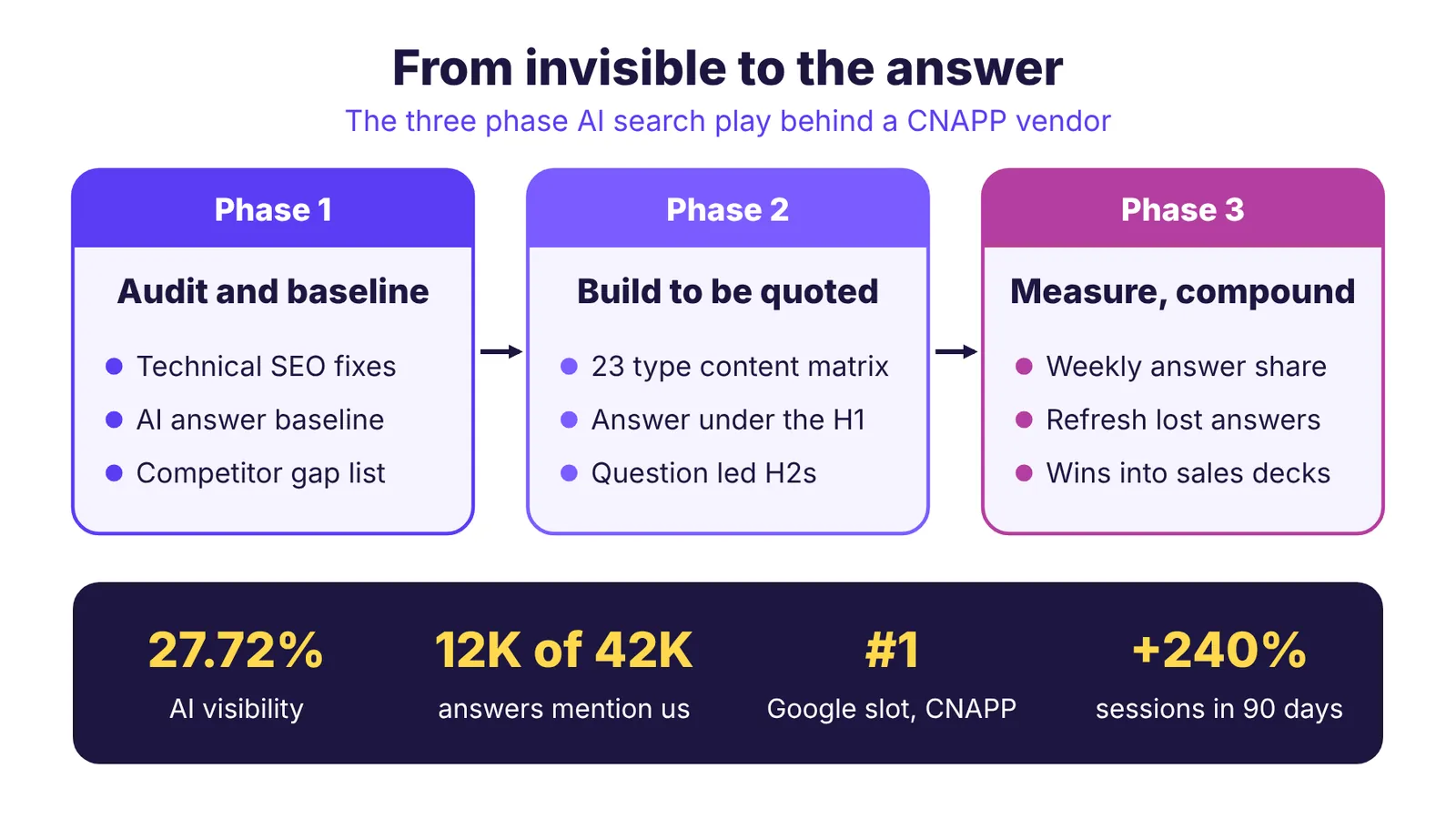
Phase one, audit and baseline
You cannot improve a share of answers you have never measured. We started with:
- A technical SEO audit and fixes across the site
- A baseline share of AI answers, tracked on LLMLab
- A competitor gap list of the buyer questions where rivals showed up and we did not
The gap list became the content plan. No brainstorming required.
Phase two, build pages AI wants to quote
This is where most of the four to six months of SEO, SEM and backlink work went. We built a 23 type content matrix. Thirteen formats drive traffic, such as definitions, FAQs and ultimate guides. Ten drive AI visibility and conversions, such as comparisons, alternatives, checklists, templates and free tools.
The pattern on our key pages was simple:
- A 40 to 80 word answer right under the H1
- A few H2s phrased as the real questions buyers ask
- An llms.txt file that points crawlers to the best pages
The lesson from the AEO and SEO case study is blunt. AI answer engines cite pages that answer buyer questions directly. Comparisons, checklists and clear definitions earned citations far more often than product pages did.
Phase three, measure and compound
We tracked share of AI answers every week. When a competitor gained citations on a question, we refreshed that page. Wins went straight back into sales and partner messaging, so the same proof showed up in decks and on calls.
Content refresh ran as its own engine, one of eleven we built to feed inbound. Others included vs and alternatives pages, same day point of view posts when a zero day hit, and concise top and middle of funnel answers built to win AI Overviews. The GTM engine page lists all eleven.
What changed?
Here is what the work produced. AI visibility comes from LLMLab, tracked from November 2025 to August 2026. Traffic comes from Google Analytics 4, May to August 2026 against the previous period.
- 27.72% AI visibility across the security category, mentioned in 12K of 42K tracked answers
- Third in AI visibility behind Wiz and Palo Alto Networks, and ahead of Sysdig and Prisma Cloud
- The #1 Google answer slot for CNAPP vendors, above Sysdig, Lacework and Fortinet, which our CEO called out in a note to the whole company
- 2x AccuKnox citations in the AI Overview for stateful prompt firewall
- Website sessions up 240.6% to 311K in 90 days, with engaged sessions up 253.1%
One honest note on that last line. The 240% came from the whole inbound engine, with landing pages, free tools and tracking running alongside AI search. AI visibility was one gear in that machine, not the only one. Anyone who tells you a single tactic tripled traffic is selling something.
What the AEO leaders found
Two outside sources line up closely with what we saw.
Ethan Smith of Graphite went deep on this on Lenny's Podcast in September 2025. The episode notes claim ChatGPT traffic converts six times better than Google search. They name landing pages, YouTube videos and Reddit comments as the tactics that work, and they flag help center content as a way into the long tail. They also say AI generated content does not work, which matches my experience. Engines reward pages with real answers, not rewrites of rewrites.
Graphite's Webflow case study shows the same pattern in a different category. Between January and July 2025, Webflow's share of voice in LLM answers rose from 33% to 64%. The share of sign ups coming from LLMs doubled from 4% to 8%, and LLM traffic converted to sign up at 24%, against 4% for non brand SEO. Two tactics stand out. Webflow added answer ready copy above the fold on about 1,500 template pages, and rewrote blog headers as questions, which lifted AI visits 58% against a control group.
Question headers, a direct answer up top, comparison pages. Different teams, different categories, one pattern.
Where do small teams go wrong?
From running this with a lean team, these are the traps I see most:
- Tracking rankings but never tracking share of AI answers
- Writing product pages when buyers ask comparison questions
- Skipping Organization and Person schema with sameAs links, the cheapest entity fix there is
- Ignoring authority. A Domain Rating under 30 means fewer citations, whatever your markup says
What to do this week
- Write down the five shortlist questions your buyer asks, then ask them in a fresh ChatGPT and Gemini chat. Note who gets named.
- Score your readiness with the AI visibility checker. It takes two minutes.
- Run your home page and your best comparison page through the SEO and AEO score and fix every high priority item.
- Rewrite the top of one money page so a 40 to 80 word answer sits under the H1.
- Turn three H2s on your best blog post into the questions buyers type.
If you want the templates behind this play as they ship, subscribe to Pipeline Notes at https://syedhadi.substack.com.