
People ask me what the one thing was. There was no one thing. I was part of the team on the AccuKnox 0 to $10M hypergrowth journey, and what got us there was six ordinary plays, run every week, each one reporting into pipeline.
Welcome to the first issue of Pipeline Notes. Each issue takes one play apart, with the numbers and a template you can copy. This issue is the map.
Why plays beat hacks
Maja Voje, writing on Kyle Poyar's Growth Unhinged, frames early GTM as a hunt for at least one repeatable, scalable motion. In her stage model, first customers usually come from the founders' own networks. Pilots, case studies and references then carry you from that early customer profile up to the real ICP.
That matches what I saw. A hack gives you a spike. A play gives you a motion you can run again next quarter with a different person at the wheel. Our job was to stack plays until several of them were repeatable at once.
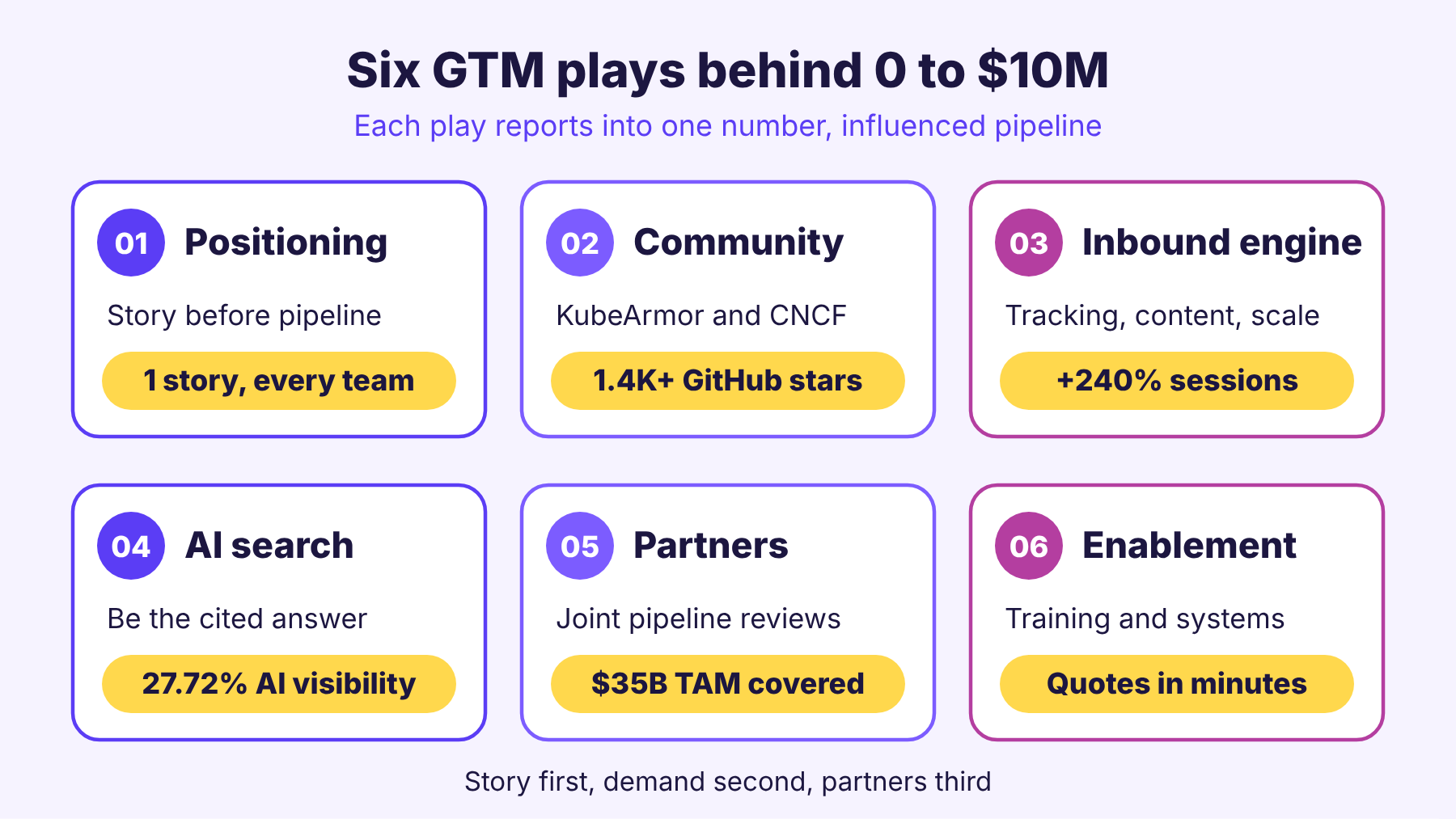
Here is the map, with the proof for each one.
Play one is positioning before pipeline
When I became the founding product marketer in March 2024, we had a technical CNAPP platform, no positioning, no sales enablement and a crowded field of well funded rivals. Nobody needed another feature list. They needed one story the whole company could repeat.
So we started there:
- Positioning, personas and messaging for each product line
- Battlecards and enablement for sales and partners
- GTM for new product lines, which drove a sharp rise in inbound leads
The lesson I wrote down in the GTM and PMM case study still holds. Positioning makes every pipeline motion cheaper. Build the story first, then point demand and partners at it.
Play two is community where practitioners already gather
Lenny Rachitsky studied how about 20 B2B companies found their first customers. His research on the first ten customers found three channels: your personal network, the places customers already gather, and press. Most companies used the network plus at least one other, and press rarely got anyone started.
Security has its own version of this story. Unusual Ventures' write up on Snyk shows a team that launched a free CLI tool in October 2015 and went straight at the Node.js community. Their logic was simple: "developers like depth, while security needs breadth." They had 1,000 users within four or five months. Then the catch. Developers did not hold the budget, so a paid tier barely sold until Snyk added an enterprise motion aimed at security leaders. The first enterprise customer arrived in March 2017.
Our gathering place was KubeArmor, the CNCF runtime security project at the core of AccuKnox. I have run its community since January 2022, and the events page has the receipts:
- A booth push that added 1.4K+ GitHub stars
- A KubeCon India capture the flag with 500+ sign ups and 300+ new stars
- Back to back #1 Startup Awards at Security BSides Bangalore in 2025 and 2026
The Snyk lesson applies here too. Community earns trust with the people who run the clusters. You still need a second motion that reaches the person who signs.
Play three is an inbound engine that reports into pipeline
Before this play, pipeline depended on events and outbound. The website described the product but did not create demand, and nobody could trace which channel produced which deal.
We fixed it in a strict order:
- Tracking first. GA4 events on every conversion that matters, account intelligence from Factors.ai, and clear target account lists for sales.
- Content second. Landing pages for each use case and buyer, pillar content and free tools, shipped on a weekly cadence.
- Scale third. Weekly pipeline reviews with sales, and more budget for the channels that convert.
The GTM case study has the numbers. Website sessions grew 240.6% to 311K in 90 days, engaged sessions grew 253.1%, and the engine supports $2M in influenced pipeline a year on a $100K a year marketing budget.
Play four is AI search before the field caught on
Security buyers now ask ChatGPT, Gemini and Google AI Overviews which CNAPP vendors to shortlist. If you are missing from that answer, you are missing from the deal before sales hears about it.
We spent four to six months on SEO, SEM and backlinks, built a 23 type content matrix for AI visibility, and tracked share of AI answers on LLMLab. AccuKnox reached 27.72% AI visibility, mentioned in 12K of 42K tracked answers, and took the #1 Google answer slot for CNAPP vendors. That put us third in the security category behind Wiz and Palo Alto Networks, and ahead of Sysdig and Prisma Cloud.
The full AEO and SEO case study is live, and the next issue of Pipeline Notes breaks this play down step by step.
Play five is partners who bring pipeline, not logos
A partner program can look busy and produce nothing. Ours runs with distributors, MSSPs and resellers across India, MENA, APAC, Japan, Europe, Africa and the US, covering $35B of annual TAM.
The part that makes it work is boring on purpose:
- Joint pipeline reviews with each partner
- Monthly business reviews with a shared view of every deal
- The same battlecards and enablement our own sellers use
A partner without a joint pipeline review is a logo on a slide. The partner revenue case study goes deeper.
Play six is enablement and systems that remove friction
The last play is the least glamorous and the one people skip. We drove adoption through self paced training, free trials and event evangelism, and we turned recurring objections into battlecards.
Then marketing started building tools for everyone else. Five org wide apps shipped by marketing now run across sales, finance and engineering. One of them, a price quote generator, cut the time to produce a quote from days to minutes. Every hour a seller does not spend on admin is an hour back on a call. See the systems page for the rest.
What the six plays share
Look across all six and the pattern is plain. Story came first, demand came second, partners came third. Every motion reported into one number, influenced pipeline. And we kept running them after the first win, which is where most teams stop.
My answer on the secret behind our 5x marketing growth is short. "Nothing fancy. We execute." If you want to see every result in one place, the case studies page has them all.
What to do this week
- Write your positioning in one sentence and read it to three sellers. If they cannot repeat it, fix that before you buy traffic.
- Add a GA4 event to every conversion that matters, so the next quarter of content can be judged on pipeline, not pageviews.
- Ask ChatGPT and Gemini the shortlist question your buyer asks. Then run the AI visibility checker to see why you are in or out.
- Pick one place your practitioners already gather and show up there every month.
- Book a joint pipeline review with your best partner and bring a shared deal list.
Next issue, I take play four apart line by line. Subscribe to Pipeline Notes at https://syedhadi.substack.com so it lands in your inbox.