

Most FIRE plans in India start and end with one number, the mutual fund SIP. That plan is incomplete. Your payslip, your PPF passbook and your NPS statement are already building a retirement corpus every month, and if you leave them out, you either work years longer than you need to or you panic and take risks you do not need.
So let us do the full math, the way I built it into the FIRE calculator.
The four buckets most people forget
When people say "my FIRE corpus", they usually mean equity funds and maybe a few stocks. Four buckets quietly sit outside that picture.
- EPF. Every month, 12% of your basic pay goes in from you, plus your employer's share. The EPF rate for 2025 26 is 8.25%, ratified by the government in June 2026. ThePrint reports this is the third year in a row at that level, for a base of over seven crore contributing members.
- PPF. The PPF rate for October to December 2026 is 7.1%, unchanged, as announced by the Department of Economic Affairs in the Ministry of Finance. The tenure is 15 years and deposits are capped at ₹1.5 lakh a year. The rate is reset every quarter, so treat it as today's number, not a promise.
- NPS. Under the PFRDA changes announced on 19 December 2025, non government subscribers can now take up to 80% as a lump sum at normal exit, and only 20% must buy an annuity, down from 40%. Corpora up to ₹8 lakh can come out fully as a lump sum. For the All Citizen Model, normal exit is now at 15 years or age 60, whichever comes first.
- Gold, FDs and cash. Sovereign gold bonds, gold ETFs, your FD ladder and the emergency fund. They grow slowly, but they count, and they are the money you will touch first in a bad market year.
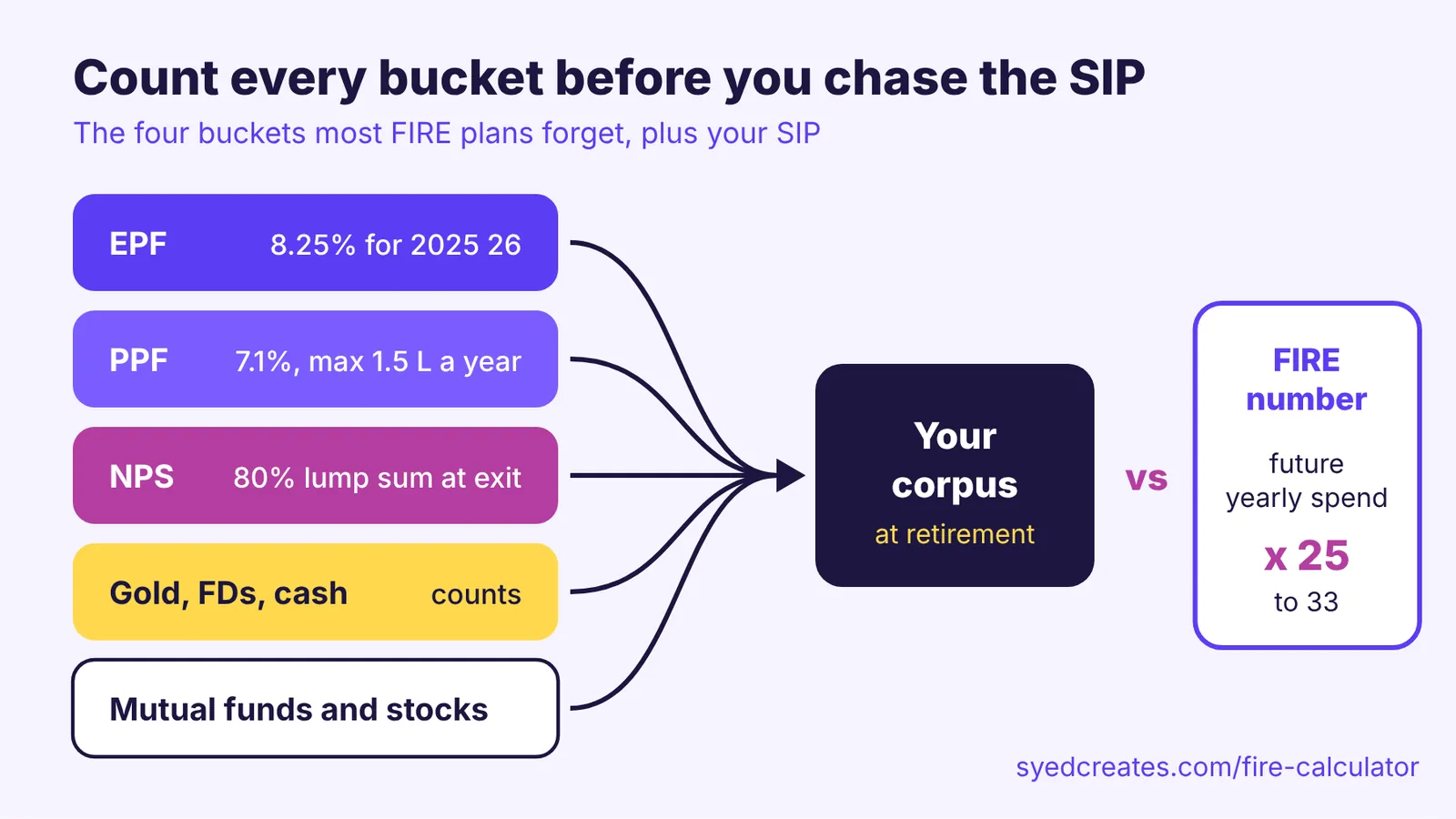
The calculator grows each bucket at its own rate. Defaults are EPF at 8.25%, PPF at 7.1%, NPS at 10%, FDs at 6.5%, gold at 8% and savings at 3%. Every one of them is editable, and you should edit them.
The 25x rule and why India needs a buffer
The 25x rule says you are financially independent when your corpus is 25 times your yearly expenses. It is the 4% rule turned around: if you withdraw 4% in year one and raise it with inflation, the money should last.
That rule came from US data. Even there, the number has moved. Morningstar's research puts a safe starting withdrawal rate at 3.9% for a 30 year retirement, with a 90% chance the money lasts, on portfolios with 30% to 50% in equities. It also warns that poor returns or high inflation in the first five years raise the risk of running out.
Now look at an Indian FIRE plan. Retire at 45, plan to 85, and you need the money to last 40 years, not 30. Indian inflation also runs higher. That is why the calculator FAQ suggests many Indian planners use 3 to 3.5%, which means a corpus of roughly 28 to 33 times your yearly spend.
Why inflation is the number that decides everything
Your FIRE number is not 25 times what you spend today. It is 25 times what you will spend the year you stop working.
The RBI gives you a reference point. In its August 2026 policy statement it projected CPI inflation for 2026 27 at 5.0%. In October it raised that projection to 5.2% and lifted the repo rate to 5.50%. Your personal inflation is often higher than CPI, because school fees, rent and healthcare rise faster than the average basket. That is why the calculator defaults to 6%.
A 1 point change in inflation over 15 years shifts your target by crores. Run the plan at 6% and at 7% and see the gap for yourself.
A worked example with illustrative numbers
These numbers are illustrative, chosen to show the math. They are not a recommendation and they are not my own portfolio.
Meet a 30 year old salaried employee who wants to retire at 45.
- Spends ₹60,000 a month today, so ₹7.2 lakh a year
- Inflation assumed at 6% a year
- In 15 years, that spend grows to about ₹17.3 lakh a year
The FIRE number at 25x is about ₹4.3 crore. At a 3.5% withdrawal rate, closer to Indian reality for a 40 year retirement, it is about ₹4.9 crore.
Now add the buckets most people skip, using the same illustrative inputs.
- EPF. ₹3 lakh balance today, ₹7,200 a month from employee plus employer, a 10% yearly step up with salary, at 8.25%. After 15 years, roughly ₹56 lakh.
- PPF. ₹1.5 lakh a year, the maximum, at 7.1%. After 15 years, roughly ₹39 lakh.
- NPS. ₹5,000 a month with a 10% step up, at an assumed 10%. After 15 years, roughly ₹36 lakh.
Together that is about ₹1.3 crore, close to a third of the ₹4.3 crore target. Ignore it and you overshoot your SIP target by a lot. Count it and the SIP you need drops sharply.
There is a catch with NPS. Money that unlocks at 60, or after 15 years, cannot fund the years before that. If you retire at 45, plan your early years on equity funds, FDs and PPF, and let EPF and NPS cover the later decades.
How the calculator handles it
The FIRE calculator works in five plain steps.
- Grows your monthly spend with inflation to your retirement year
- Works out the corpus that pays those rising expenses until the age you choose
- Adds a tax and safety buffer, 10% by default
- Grows every bucket at its own rate, with SIP, EPF and NPS stepping up each year and PPF capped at ₹1.5 lakh
- Compares your projected corpus with the FIRE number, and if you fall short, shows the SIP that closes the gap
It also shows Lean, Regular, Fat and Coast FIRE side by side, and you can download the plan as a PDF. If you want to sanity check your equity return assumption, look at real 5 to 20 year numbers in the mutual fund returns tracker before you type 15% into anything.
Three common mistakes in Indian FIRE plans
- Using today's spend. The FIRE number depends on future spend, and inflation compounds just like returns do.
- Treating NPS like a liquid fund. It is retirement money with rules. Model when you can actually use it.
- Assuming the best year forever. Equity can fall 30% or more in a bad year. Run a lower return and check your margin.
This post is education, not financial advice. I am not a SEBI registered investment adviser, so speak to one before you act on any projection.
What to do this week
- Download your EPF passbook and your latest NPS statement and note both balances
- Check your PPF balance and whether you deposited this year
- Enter all of it in the FIRE calculator, with inflation at 6% and then at 7%
- Note the SIP gap, then see how much a 10% yearly step up closes it
- Put a reminder to rerun the plan next November with real numbers
If this was useful, subscribe to Pipeline Notes at https://syedhadi.substack.com for the next Money Note.